Sans Souci Palace in Potsdam
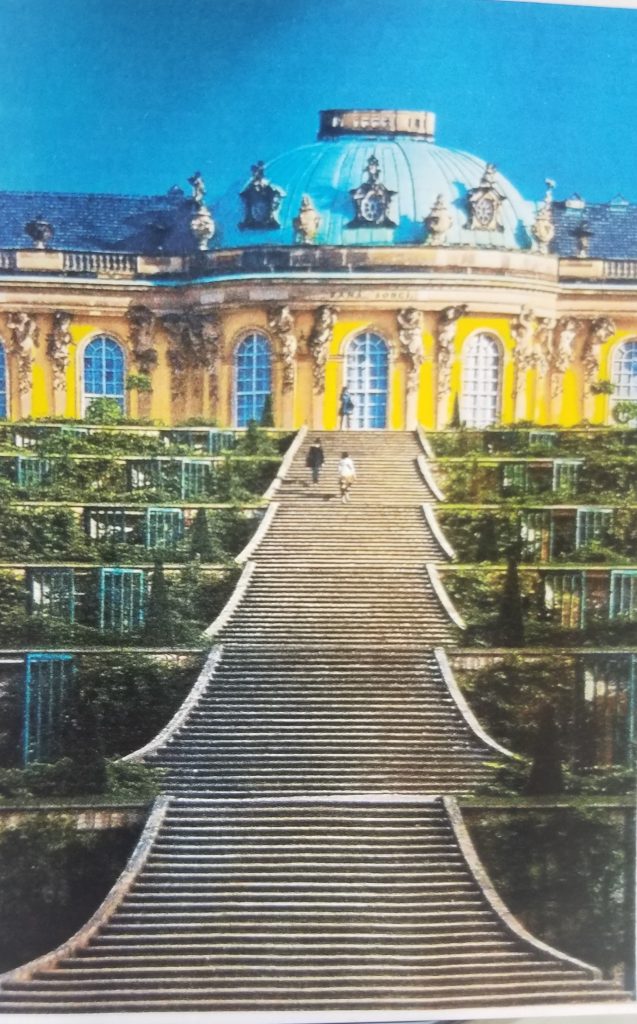
It was the pleasure palace of Kaiser “Emperor” Frederick the Great and it featured beautiful Rococo style architecture and a magnificent Palace Garden and vineyard that Frederick the Great had planted, terraced by the stairs. On April 14th, 1745, the foundation stone was laid for today’s world-famous Sans souci Palace. Sans souci is a masterpiece ensemble of architecture, sculpture and garden art. Frederick the Great was the Emperor of Prussia.
It was the summer of 1943. I was 16 years old and was allowed by my mother to take the train one more time to visit my dear Aunt Frieda and Uncle Christopher in Calau, outside Cotbus, south of Berlin. The bombing situation got to be too dangerous for me to undertake this journey by train. It was a great target for the B-17 bombers. I often spent my summer vacations there, while growing up. My Uncle Christopher was a breeder of fine horses, and I loved horses and riding.
My train took me to Berlin and my father, stationed there, picked me up and before I would continue my journey to Calau I spent the day with my father. First, after arriving in Potsdam my papa took me for an awesome lunch to a restaurant called “Café Repin” near the picture gallery and Sans souci palace. A beautiful buffet was laid out in this charming and very elegant Café, of all kinds of seafood salads or seafood, grilled dishes with green or fruit salads. A very aromatic French press coffee and an endless list of wonderful desserts on a dessert menu. We had a two-hour lunch and while we enjoyed this awesome food, we loved our time together. When the afternoon sun disappeared, it was time for me to return to the train station to continue my journey to Calau, where Franz, Christopher’s driver awaited me with his horse-drawn carriage.
The drive from the Calau train station to the estate brought us through a serene forest, passing by an idyllic lake with wild geese enjoying the clear, clean water, and we arrived at Aunt Frieda’s estate. Franz took care of my luggage and after big hugs from my aunt and uncle we went into the house. Aunt Frieda and her husband were breeding and raising beautiful horses. It was a marvelous place to spend some weeks during summers. There was a pond for swimming, a wonderful meadow in which to play in or just sit, relax and daydream of one’s future, what it might yet hold for a 16-year-old girl. Or wander through the poppy fields, picking a bouquet of poppies for my aunt, only to have all the pretty red petals fall off before I would get to the house. What beautiful sight to behold, as far as the eye can see, beautiful red poppies moving in the summer’s breeze.
On Sunday afternoon I would await anxiously Aunt Frieda’s specialty for teatime. A delicious pastry my aunt called “Kalte Schnauze” cold snout. It was built in a loaf pan with alternating layers of lady fingers and chocolate ganache. Put into the refrigerator overnight and sliced into thin slices and served with whip cream. I would love it and the guests would love it. Later that year I wrote to my aunt and asked her for the recipe of this wonderful dessert. Soon a package arrived, and in it was a beautiful tin with the “real thing” a wonderful cold snout and with it, the recipe. I still to this day know the recipe and have made it many times for my dear husband Hal.
This was my last visit to my favorite place with my favorite aunt and uncle. Bombing attacks on trains in that part of Germany were very frequent and my dear mama thought it too dangerous for travelling.
The war ended and made an end to this life-long relationship. When the Russian hordes came through that pristine area in 1945 on their way to Berlin, all these beautiful estates were pilfered and burned to the ground and the families who lived there were murdered. Uncle Christopher and Aunt Frieda’s son lost his life already in Africa at the battle of El Alamein. His parents gave their lives in 1945, the end of WWII.
I tearfully read the tragic end to this beautiful story. My heart goes out to Ilona, having lost so many loved ones in this terrible war. Thank you for sharing your memories.
Another poignant story. Hard to hear and important to tell. And Ilona tells it in a most compelling way. This should be published across the land. A cautionary tale about the senseless, futile and barbaric use of violence. I’m so sorry our dear Ilona has to carry these devastating memories. Too many others carry them too. When will violence become obsolete? Thank you for your courage to write and share these important truths, Ilona. I hold them and you in my heart.